

Are you in search of information on items allowed through TSA screening? If so, you’ve come to the right place. TSA has so many rules and regulations, yes, for our safety, that it can be confusing to weed through them all. At one time or another, we’ve all felt the deep-seated fear in the pit of our stomachs while standing at the security checkpoint. The fear of not knowing if you put something in your luggage that isn’t allowed.
As a seasoned traveler with extensive knowledge of TSA guidelines, I can help you navigate the rules of flying and stay within the realm of TSA regulations. I was in your shoes many years ago, with fear wrenching my gut as I stood in line at the security checkpoint.
If you value knowing what to pack so you can move through the security checkpoint more smoothly, then this guide will help. Let’s embark on this journey together. We’ll take an extensive look into the world of items allowed through TSA screening.
What is the mind blowing information of TSA rules and restrictions?
TSA covers various aspects of travel, and they set regulations for what you can and can’t bring on a plane and where you need to pack your items. This is where “mind-blowing comes into play. The sheer magnitude of TSA guidelines is overwhelming. In this article, we will cover many areas that TSA regulates. But first let’s understand TSA and their function.
History Of Transportation Security Administration
After the 9/11 terrorist attack, the U.S. federal government formed the Transportation Security Administration (TSA) to improve security at airports.
Congress passed the Aviation and Transportation Security Act (ATSA), which President George W. Bush signed into law. Initially, the TSA was under the authority of the U.S. Department of Transportation. In 2002, the department merged into the newly created Department of Homeland Security.
Today, the security administrator for transportation has approximately 60,000 people who help keep our country safe by protecting the U.S. transportation system.
What items are allowed through TSA screening?
Most of us focus on our bags when flying. We don’t always know what items allowed through TSA screening actually are and what TSA agents are doing unless they stop and check our luggage. The TSA is always trying to improve its processes to better protect travelers from terrorism. Things can change in a nanosecond. The changes may be due to new knowledge unknown to the general public and could require additional measures to ensure safety.
In this article, we will cover different aspects of common security scanning regulations for flying. The areas that can affect your travels like checked luggage, carry on luggage, TSA PreCheck, and so much more. To navigate to the area you want to learn more about, scroll up to the table of contents to find the heading you are looking for.
Checked Luggage?
When we talk about items commonly allowed through TSA screening, we must include checked bags. The checked baggage process is for people who want to bring a larger amount of personal belongings that will not all fit in their carry on luggage. You should consider checking your bags if you’re going to bring full-size toiletries, multi tools, sharp objects, and other items you can not take in your carry on.
When you arrive at the airline ticket counter, the attendant will weigh your checked luggage and place it on the conveyor belt. From there, it travels up to a mile to get to your plane’s cargo hold. If your aircraft has not arrived, the baggage will sit in a waiting area during the trek to its destination.
During the complex mile trip, the airport personnel load your luggage onto a cart and bulk scan for any signs of explosives. Then, it is loaded into the cargo hold of your airplane.
TSA Requirements For Checked Luggage
Checked luggage has guidelines you must follow, but each airline sets its own restrictions for dimensions and weight restrictions. It is best to check the airline you will fly with after looking at the requirements.
Many airlines commonly set checked-bag limits around 50 lb in weight and 62 linear inches in size, but sometimes less or more, depending on the ticket/airline, so always confirm your airline’s current policy for a checked bag. To figure out the linear inches for your bag, simply add the width, length, and depth of your bag. For example, if the overall dimensions of a suitcase if 27.95″ × 19.6″ × 13.4″, then the linear measurement is 27.95 + 19.6 + 13.4 = 60.95 linear inches.
List Of What Can NOT Go In Checked Luggage?
Because these are items commonly allowed through TSA screening, I have made a list of items that are often restricted in checked luggage or may have special conditions, depending on what the item is and how it’s packed. Some are obvious, and some are eye-openers.
| lithium Ion batteries | English Christmas crackers | power banks |
| vapes of any kind | lithium metals | power chargers |
| anything labeled as hazardous material | Compressed Gas Cylinders | propane |
| alcohol greater than 140 proof | fireworks | Realistic replicas of explosives |
| plasma lighters | flammable paint | electronic, arc lighters |
| bear banger | flares | safety matches |
| biological specimens no more than 30 ml preservative solutions | fuel cells | Samsung Galaxie note 7 |
| blasting caps | fuel of any kind | Small Compressed Gas Cartridges |
| no more than 68 fl oz of aerosols | gasoline | Sparklers |
| no butane curling irons | gun lighters | Spillable batteries |
| fuel or fuel vapors | gun powder | Spray Paint |
| chlorine for spas and pools | hand grenades | Spray Starch |
| CO2 cartridge | hoverboards (check with airline) | Strike-anywhere Matches |
| compressed air cylinders | lighter fluid | Tear Gas |
| cooking spray | liquid bleach | Torch Lighters |
| drones | live coral | Turpentine |
| dry ice (check with airline) | live fish | Vehicle Airbags |
| dynamite | medical marijuana greater than 0.3% THC | Mercury Thermometer |
| EPIRB (check with airline) | oxygen | E-lighters |
| party poppers | permeation devise with more than 2 ml hazardous waste in it | bear spray |
| Paint Thinner | no more than 68 fl oz of medicinals | gas torches |
Carry On Luggage
In our comprehensive article, we covered checked luggage, but there is also another type of baggage. When traveling by air, you can take luggage onto the plane, which is known as carry on luggage. But what is considered a carry on bag?
A carry-on bag is a bag or suitcase that may include clothes, toiletry items, books, etc. A carry-on might be all you need if traveling for a short trip or a weekend away.
TSA sets rules for what can go through screening, but airlines set carry-on size and weight limits.
When in doubt, treat TSA as the screening authority and your airline as the authority on bag size/weight and whether an item must be checked.
TSA Requirements For Carry On Luggage?
In our article, we will cover carry on luggage. TSA does not set the regulations for size and weight for a carry on bag. However, TSA does give a guideline but suggests you contact the airline for exact dimensions.
The guidelines for dimension and weight for a carry on are 22 in x 14 in x 9 in, but your airline’s limits can differ.
Each airline sets its own rules according to the size of the plane. Smaller planes have less overhead storage; therefore, the size limits are smaller. Check with the airline you will fly for its policy.
3-1-1 Rule?
TSA created the 3-1-1 rule after 911 to help protect passengers. The rule is about how much and how many liquids you can carry onto a plane. Some liquids can trigger the scanners, so it is easier to limit the quantity to protect all passengers.
What Does 3 1 1 Mean
- The 3 in the 3 1 1 liquid rule refers to the amount of liquid you can carry in a bottle onto your flight, either in your carry on luggage or personal carry on. So you must follow the TSA ounce limit. Liquids must be in containers of 3.4 oz (100 ml) or less, placed in a single quart-sized bag.
- The first, 1 in the 3 1 1 rule, refers to a one-quart size bag. You can stuff all the liquids you can fit into this one-quart size bag. The bag must be clear and no larger than a quart.
- The second, 1 in the 311 TSA rule, refers to how many bags one person can carry onto the plane. Each person can have only one quart-sized bag with liquids as a carry on item, so if you are traveling alone, then only one bag. But if you have children who carry their own carry on luggage, they can also have one bag apiece.
What Can I Put In My Carry On?
Here is a list of items commonly allowed through TSA screening you can take in your carry on bag. Please remember to look at the 3-1-1 rules on how to carry these types of items.
Items List For Carry On Luggage
| Alcohol 3.4 ounces and less than 70% alcohol content | E-liquids 3.4-ounce bottles or less | Liquid foundation 3.4 oz or less | Peanut butter 3.4 oz or less |
| Cream cheese 3.4 oz or less | Eye drops 3.4 oz or less | Liquid soap 3.4 oz or less | Salad dressing 3.4 oz or less |
| Chocolate liquid 3.4 oz or less | Eyeliner 3.4 oz or less | Lotion 3.4-ounce or less container | Shaving cream 3.4 oz or less |
| Conditioner 3.4 oz or less | Hair gel 3.4 oz or less | Makeup remover 3.4 oz or less | Soups 3.4 oz or less |
| Cream 3.4 oz or less | Jelly 3.4 oz or less | Maple syrup 3.4 oz or less | Toothpaste (small size) |
| Cream spreads and dips 3.4 oz or less | Liquid detergent 3.4 oz or less | mascara 3.4 oz or less | Vitamins (liquid) 3.4 oz or less |
What Exactly Is TSA PreCheck?
TSA PreCheck is a program that offers expedited screening for eligible travelers at participating airports. In other words, you apply and undergo a background check to prove you are a safe bet. Because of your background clearance, you have special perks that other passengers may not get, like you can leave your shoes on, leaving your jacket or sweater on, and keeping your electronics in your bags.
You must apply, get your fingerprints, and get a background check to become TSA PreCheck. But once you pass all the checks, you are good to go for 5 years. TSA PreCheck just makes your travel life a bit faster and easier.
When my husband recently scheduled a flight for me, he failed to put my TSA PreCheck number in when he booked it. I didn’t realize this until I printed my tickets. Needless to say, I didn’t have my number with me to put it in during check-in. I had become so used to sliding through on a Precheck that I had forgotten how much easier it is with TSA clearance. Sometimes it is good to have those subtle reminders.
What Is A TWIC Card?
The Transportation Worker Identification Card, also known as a (TWIC Card) is an official photo I.D. with an integrated security chip. The chip holds personal information on a security chip, like fingerprints. There are TWIC card requirements that state only specific people can apply for a TWIC Card. People who work in the transportation industries and require admission to secure areas like maritime facilities are eligible.
A TWIC card is primarily used for access to certain secure facilities (especially maritime) and does not function as a general ‘skip-the-line’ airport passenger screening program. The card has all their information on it with a metal slide, much like a credit card, with data from a background check of the person who holds the card.

What About Flying With Kids?
Flying with kiddos can be a bit different than adults. Let’s break it down by age to help clarify this statement.
Infant and babies for items allowed through TSA screening
When you fly with your infant or baby, there are a few special rules to help promote a smooth transition through security and when boarding your flight.
Although this is not a rule, you will want an infant carrier that is cloth because you can place your infant in it, and both of you can scan simultaneously. A carrier will free your hands to introduce personnel to your carry on items.
You can hold your baby on your lap for the flight, but if you would prefer to place your infant in a baby carrier, you can purchase a ticket for them. If there happens to be an empty seat and the airline allows it, you may be able to use the infant seat; otherwise, it may need to be gate-checked. Carry your infant seat through security as if taking it on the plane. Once you are boarding, if the flight is full, you can gate-check the seat and hold your baby throughout the flight.
Some airlines provide bassinets that fold down from the wall of the plane. If you plan to use these, I suggest you check with your airline to know the use rules and to reserve one.
A List Of Baby Items Commonly Allowed Through TSA Screening You Can Carry On
Because things are different for babies and toddlers, so are the rules for what you can carry on a plane in your diaper bag.
| # | Baby Items | Details for baby items allowed through TSA screening |
|---|---|---|
| 1. | diaper Bag | Many airlines allow a diaper bag in addition to a carry-on, but policies vary; best to check your airline. |
| 2. | diapers | You probably change your babied diaper every 2-3 hours; bring enough for your flight + 2 more |
| 3. | diaper wipes | You probably change your babied diaper every 2-3 hours; bring enough for your flight + 2 more. |
| 4. | changing pad | Any size is typically allowed through TSA screening, but a small one will save room in the diaper bag; NO metal in the pad |
| 5. | extra baby clothes | Any clothing made of all cloth, plastic snaps work but no metal snaps |
| 6. | sanitary wipes | You can take a full-size container of sanitizing wipes |
| 7. | bottled formula | Premade baby formula is typically allowed through TSA screening when traveling with an infant, though additional screening may occur. |
| 8. | powdered formula | A bottle of premade formula is acceptable. Please consider how you will warm it. Portable bottle warmers are available for purchase, or ask for hot water to warm the bottle. It is considered medically necessary. |
| 9. | breast milk | You can transport breast milk in bottles or plastic breast milk bags on ice. Breast milk is typically allowed through TSA screening and may be subject to additional screening. |
| 10. | breast pump | A separate breast pump is not considered a carry on but rather a separate piece and is thought of as medication. |
| 11. | bottle warmer | Portable baby warmers are available for purchase, and you can put them in your diaper bag along with other acceptable items. |
| 12. | ice packs | Ice packs are typically allowed when used to keep breast milk or formula cool, though additional screening may occur. |
| 13. | cover for nursing | Nursing covers are cloth items and are typically allowed through TSA screening. |
| 14. | empty bottles | Glass bottles are acceptable, but I suggest non-breakable bottles to save a mess if the glass breaks |
| 15. | burp cloth | Take a few clothes as we all know, our babies go through them quickly |
| 16. | pacifier | Be sure to have extra of your baby’s favorites, as they are commonly allowed. |
| 17. | baby blankets | All cloth baby blankets are typically allowed through TSA screening. |
| 18. | baby medications | Baby medications are considered necessary for travel according to TSA guidelines |
| 19. | diaper rash ointment or cream | Full-size containers are acceptable |
| 20. | baggies | Baggies to put your wipes and dirty diapers in are acceptable. |
TSA Screening Tips For Kids
TSA has a saying, “Kids rule the airport,” which means that more things are permissible, and they make it easier when you fly with your child. Airport security intends to offer respect to you and your child and make your transition easier.
However easy they make it to fly, you will still need to purchase a ticket for a child 2 years old or older. Children under 5 need an adult to fly with them.
The table above stating what you can take on a flight for babies also applies to toddlers. However, you can stuff some additional items in that diaper bag, such as baby food, juices, water, and some toys.
Toddlers 2–5 Years Old: TSA Screening Tips
Some airlines will allow a child aged 5 to 12 to travel alone, but most require the use of an “unaccompanied minor service.”
When an airline offers this service, it comes with a fee for each flight the child may need. For example, a round trip will require a fee two times. The average cost is around $150 per trip.
Ages 12+: TSA Screening Tips
At age 12 most airlines consider a 12-year-old an adult passenger. Which means they will go through security checkpoints just like an adult will.
Each airline is a bit different, with some allowing a 12-year-old to travel alone, yet some say age 14. To prevent issues on the day of the flight, check with the airline to see their required age.

What About Flying With Pets?
Pets can fly too. How often have you left your pet at home with a sitter and felt miserable the whole time you were on vacation? Did you know you can take your pet with you when you fly? In this guide, we will discuss small pets, large pets, and service animals.
What About Flying With A Small Pet?
You will need to follow a few requirements to fly with your pet. Most airlines do allow pets, but not all. Check with your airline and know what the specific regulations are.
If an airline allows pets in-cabin, it’s often limited to small cats and dogs, and sometimes other small pets, depending on the airline. Your pet must fit into a pet carrier that will fit under the seat. Some airlines require the carrier to remain under the seat the entire trip.
Traveling with a pet costs $35 to $225, depending on how far the flight is. The fee is a one-time charge.
According to the FAA guidelines, most airlines may require additional stipulations to follow when traveling with a pet:
- A limited list of the types of pets that you can bring into the cabin
- A limit on the number of pets in the cabin
- A limit on the number of pets that may accompany you on the airplane
- A requirement that your pet be harmless, inoffensive and odorless
- A requirement that your pet remain in the container for the entire flight
- A requirement that you be able to produce a recently issued health certificate for your pet (List borrowed from the FAA guidelines website)
What About Flying With A Large Pet?
If your pet is large and will not fit into a carrier under the seat, you may have some options to fly with your furbaby. Some airlines have temperature-controlled pressurized cargo areas for where you can stow your pet when you fly. However, the airlines that offer this service are few. Not to mention it can cost upwards of $200 and more one way. Check the airline you will fly for more details on flying with a large pet.
Can You Fly With A Service Animal?
Now let’s talk about service animals that are not considered pets but are necessary for some who travel.
According to the US Department of Transportation, the definition of a service dog is as follows:
The ACAA (Air Carrier Access Act) states that a service animal is any breed or type of dog specifically trained to perform tasks or do work to benefit a person with qualifying disabilities. These disabilities may include sensory, physical, intellectual, psychiatric, or other mental-emotional disabilities. Service animals do not include animals in training, emotional support animals that are not dogs, or companion and comfort animals.
Now that we have clearly defined a service animal, what do airlines allow? Most airlines may objectively assess the animal and question the owner as to what tasks the animal performs. For example:
- The flight crew can visually assess the animal for a harness or leash that would indicate it is a service animal.
- Does the owner appear to have a disability matching the animal’s task?
- They can observe the animal’s behavior to ensure it is safe and trained.
If these three observations do not match, the flight crew may refuse to allow the dog to travel in the aircraft’s cabin. Airlines may assess whether an animal meets the requirements for a service animal and may deny cabin transport if those requirements aren’t met. But please remember a service animal is a highly trained, intricate part of a person’s life. A real service animal would pass all three of these points without a hitch.
You and your service animal also have some responsibilities. They include but are not limited to the following:
- Your service animal can sit under the seat in front of you, or if it is small, you may hold it in your lap.
- You cannot allow your service animal to block areas that need to be open.
- Having your service animal with you does not mean you will get a seating upgrade.
- Your service animal must remain calm and nondisruptive at all times.
- If you and your service animal comply with the rules, airlines typically allow the animal to fly in the cabin.
What About Medical Conditions and Disabilities?
Disabilities, whether it is short-term or long-term, have their difficulties. Then compound that with the stress of flying and the unknown, and you have chaos.
Do not fear because airlines accommodate people with disabilities; Airlines are required to provide accommodations, and there are processes in place if you need assistance when traveling.
As a matter of fact, the TSA.gov has set up ways for you to get answers regarding TSA rules and screening guidelines. In addition, some resources allow you to reach out to let the airline know what you need when you fly.
- TSA Cares – a hotline for people with disabilities, their families, and friends to call to ask questions, so they know what the process will be to check-in.
- TSA Contact Center – a second hotline to call or email to ask questions about items commonly allowed.
- Passenger Support Specialists – You can ask for a specialist to accompany you through check-in. These TSA specialists have extensive training to help you.
- The TSA Website – has loads of information on traveling with medical conditions and disabilities.
- Twitter Account (@asktsa) – ask questions about commonly allowed items through Twitter or FB messenger.
So, don’t let a medical condition or a disability keep you from flying. And make sure to use the help available if needed.

What Is TSA Looking For When They Scan Your Luggage?
Automatically we all think the scanners are looking for drugs or money or maybe too many cigars in your luggage. But when they scan your luggage, they are looking for items that appear to be bombs, explosive materials, chemicals, and weapons.
Now, if they see some drugs that trigger a search because they resemble explosive materials, the owner of that luggage could be in a world of trouble. But to find drugs is not their intent.
Scanners can see your cigars, cigarettes, liquids, alcoholic bottles, and prescription medications. So scanners can see many items, but they are not necessarily looking for those particular things.
TSA scans your checked luggage in bulk on the luggage carts. If one bag triggers a search and they open your checked baggage, they must leave a note in your suitcase saying they conducted an investigation.
How To Fly With Crematory Remains
Flying home with the ashes of a loved one is never a happy moment. TSA does have some guidelines for crematory remains and urns, which we will cover here.
On the tsa.gov site, there are some suggestions for flying with crematory remains. TSA recommends you place the ashes of your loved one in a temporary container that is lightweight wood or plastic. You may choose a permanent urn, but TSA suggests using a lightweight container that can be screened clearly, which is often materials like wood or plastic.
TSA generally does not open urns out of respect for you and your loved one, which is why wood or plastic is the best choice. But the container must allow the contents to be screened. Some urns will produce an opaque image when scanned. If the security personnel can not get a clear view of the contents, they may not allow you to bring the urn on the plane.
Some urns can create an image that’s difficult to screen; if TSA can’t clear it, it may not be allowed through the checkpoint, thus the reason for a temporary house for the ashes.
What Are TSA-Recognized Luggage Locks?
We use locks to keep people out of our stuff. When it comes to travel, locks protect your suitcase belongings. There are such things as TSA accessible luggage locks. But why would you need a lock that meets TSA accessibility?
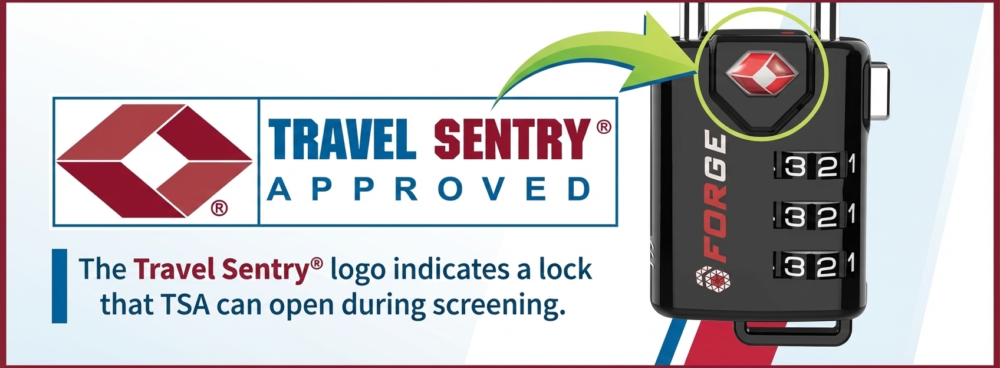
TSA personnel have a master key to all these types of locks, which means they can unlock your luggage without breaking the lock. But if your bag needs to be opened during screening and the lock can’t be opened by security, the lock may be cut off, leaving the luggage unprotected.
You can see if a lock is TSA accessible by the “travel sentry” symbol on the lock. It looks just like the one in this image, and as long as you see this symbol, you will have good locks.
Can You Fly With a Firearm?
Now that’s a tricky question because guns generally are not suitable, but you can fly with a gun if you meet specific requirements. With this said, gun cases and ammo cases are commonly traveled with.
The requirements are as follows for guns and rifles:
- Your firearm must be in a locked, hard-sided case.
- Your firearm must be empty.
- Multiple firearms may be transported in the same hard-sided case if they are properly secured.
- Always place your gun in your checked baggage, NOT your carry on.
- Declare it at the ticket check-in before you put it in your checked baggage.
- You can store the magazine in the case with your gun.
- The ammunition can be in the case with your firearm in the original ammo box.
Now, what about ammunition?
- Some airlines allow ammunition to be transported in magazines as long as the bullets are completely enclosed.
- Ammunition must be securely packed in its original packaging or a box specifically designed to carry ammunition.
- Ammunition must be in your checked luggage.
That sums up the regulations to fly with a gun in short form.
FAQs About TSA Screening Rules
Here are some commonly asked questions about items commonly taken.
What does TSA not allowed in carry-on?
Most liquids, gels, creams, and pastes must follow the 3-1-1 rule, though some items like certain medications and infant feeding liquids may be allowed in larger quantities with additional screening. The rule states these items must be 3.4 ounces or less in a 1-quart baggie and only one baggie per person in a carry on.
Does toothpaste count as a liquid TSA?
Yes, toothpaste is a paste, so it is a liquid TSA and is only allowed in a carry on in the amount of 3.4 ounces in a quart-size baggie and only one baggie per person in their carry on.
How many 3 oz bottles can I take on a plane?
As many as you can fit into a quart-size toiletry bag and still close it to follow the TSA 3-1-1 rule.
Additional Resources
If you are looking for more tutorials, walkthroughs, and troubleshooting on TSA, here are some additional posts about TSA:
Conclusion
There is so much more we can go over in this article, and we aim to be adding to this post on a more regular basis. So please stay tuned for more updates. Please feel free to comment below if you have questions or some information you want us to write on. We are here to assist you.
Thanks for reading, and we hope you have an amazing trip!
Hey Laura, awesome post. Apologies if I missed this on your list but I found out the hard way you can’t put portable Bluetooth speakers in your check in luggage either (cos of the batteries of course).
Paul
Hi Paul, thanks for the heads up. I added Bluetooth speakers to the list. We all try to comply with the TSA rules, but everything is up to the discretion of the TSA workers. Did they confiscate your speakers? If so, I bet that was hard. Thanks for stopping by and for the heads up.
Laura